
Paul Bond and I discussed “The Buys” last Thursday, and above is the video. We range in our discussion and I just did a pretty extensive post on it that I lost in Known (sometimes I am spoiled by WordPress). I’ll keep this one very short. Below are the three video clips we discussed in some detail. After that we explored the recurrence of noir aesthetics through sight and sound that Paul breaks down nicely in this post. I want to talk more about the idea of “institutional noir” —which I’m starting to feel is one name for the aesthetic of Simon’s series.
The Wire Everywhere
While walking around the new building I now work in at UMW—I realized I was seeing The Wire everywhere. Specifically, in the carpet.
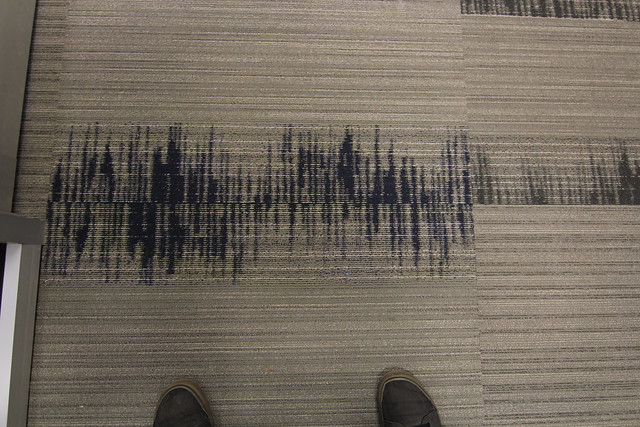
The carpet is a constant reminder, at least for me, of the iconic image that is associated with the series on its main Wikipedia page.
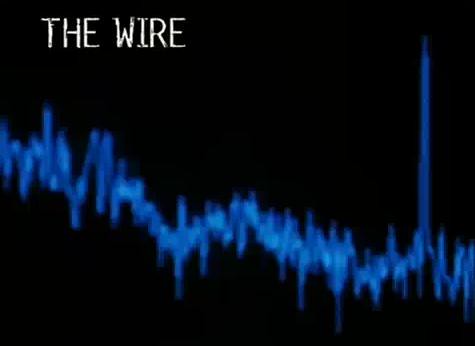
So I took a picture of the rug and then add a quick title (still working in PowerPoint ;)) and took a screenshot.
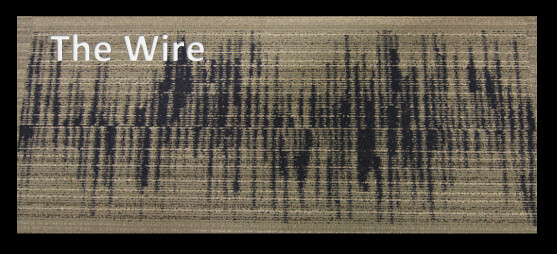
You can see a comparison here.
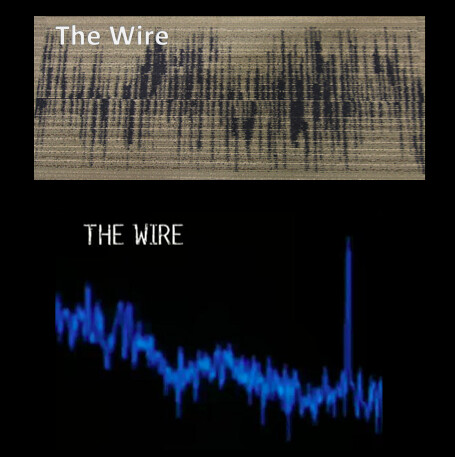
I would give myself one of the two stars I attributed to “The Wire Everywhere” assignment I created for this semester’s ds106 visual assignments. For it to be awesome, I would need to use Photoshop or GIMP to make the colors of the rug match those of the series icon. I’ll revisit this, but for now consider it yet another star, and a new #wire106 assignment to boot 
Notes on episode 4
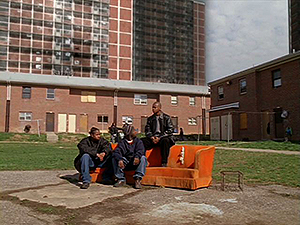 In the commentary for the first episode of The Wire, David Simon said they used CGI special effects to put the towers in behind the low-rises, because they had been torn down a few years earlier. I thought of that when I saw this shot. There’s something about the towers in the background that seems ghostly – the lighting isn’t quite right and the edge is blurred. Maybe they just ran into the limits of the technology at that time.
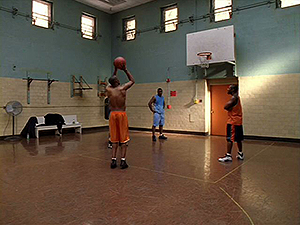
I brought up the recurring color issue last time around. We see it here again. Notice the orange that the two characters are wearing. It matches the orange of the couch in the low-rises, and the orange of the poster that Freamon found with Barksdale’s photo. And the orange of the jumpsuits prisoners wear in court.
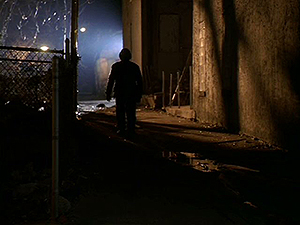

Some of the coloring and lighting in the photography strikes me as Bava-esque. That alleyway shot could come right out of Kill, Baby … Kill.
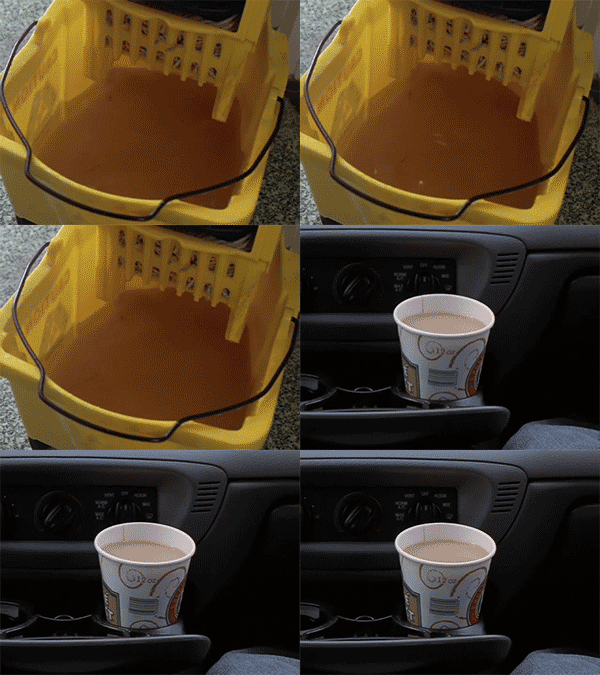
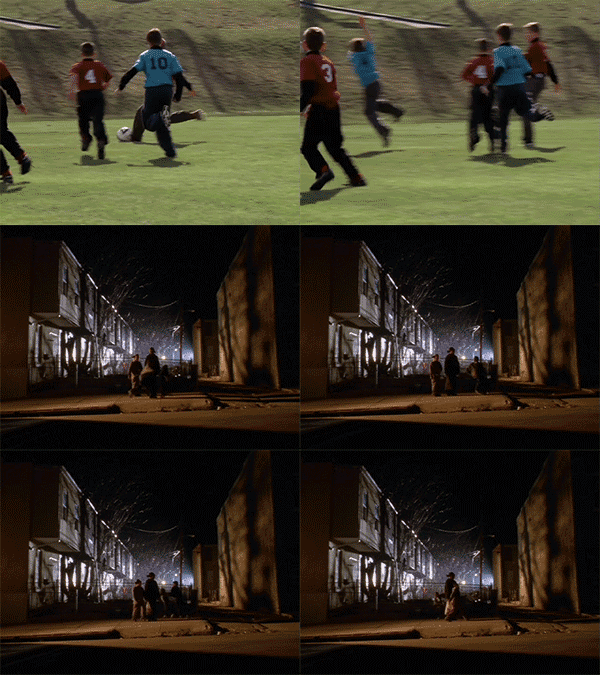
Another thing I picked up from the Bavafest was the concept of visual rhyming in shot transitions. The one is a kind of pun, as the shot switches from the janitor’s bucket to the coffee cup. The other shows an interesting contrast between McNulty’s kids at play in the bright sunlight and the other kids playing at night in the mouth of a dark alleyway.

Here’s another example of photographic foreshadowing. Presbo is hard at work goofing off with a word search puzzle. It says something about his character, much like Freamon’s hobby said something about his. Presbo’s talent for solving puzzles will soon play a key role in the storyline.
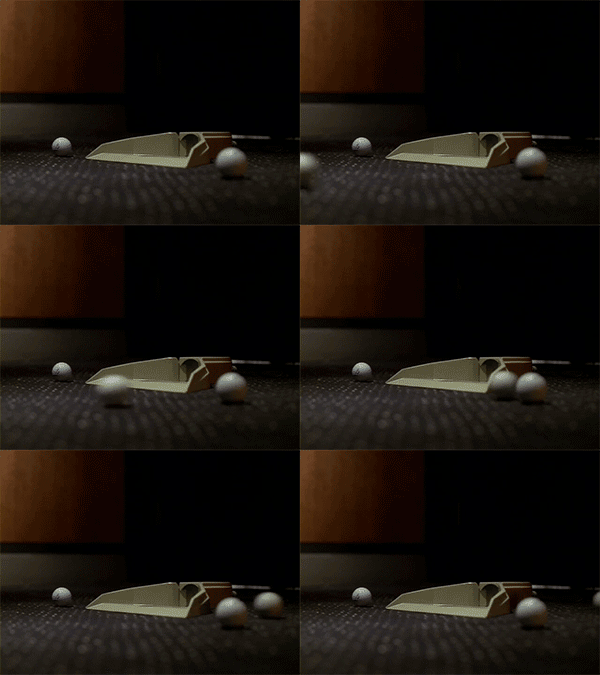
Deputy Burrell’s golf game is another picture that tells a story, always missing his shot.
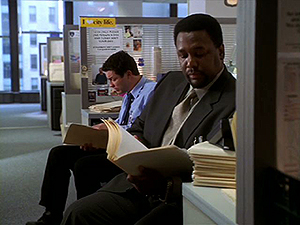
This shot I like for the composition – the repetition of the cubicle walls and the perspective of the shot.
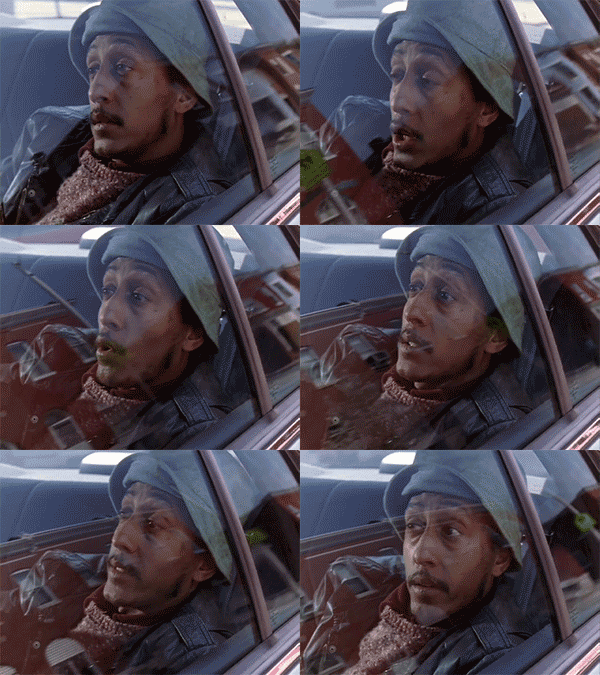
Another visual theme I’ve been seeing repeatedly is reflection. It’s related to surveillance, as we’re sometimes watching people. Sometimes we see scenes unfold through mirrors. Here we see the city go by reflected in the car window.
Sounds
In the scene where the police are searching the house for Bodie, the camera mainly stays on Bodie’s grandmother folding laundry in her living room. Most of the story is told through sound – the police at the door, the sounds of the street when the door is opened, the muffled sounds of the police looking through the rooms upstairs
The bar scene where Freamon explains how he got on the pawn detail is another with some noir-ish jazz in the background. The music creates atmosphere organically because it’s coming from the setting and not layered over it. The story ends up being pivotal in the plot of the series.
Clowny Ass Troll Quotes

While not a distinguished Triple Troll Wire Epigraph, I couldn’t resist doing an old gold Troll Quote assignment—and this quote from D’Angelo‘s treatise on power, capital and reward was hard to get out of my head. Interestingly enough, Rawls very well could have been saying this venomously to McNulty—or anyone else for that matter. And who has a more clowny ass name than Bubbles?

I did this one in PowerPoint because that’s all I had on my new computer, and it was dead simple. I broke it down quickly in my previous post. That’s two more stars of visual assignments. I’m rolling now
Triple Troll Wire Epigraphs
While writing my last post about The Wire, It struck me that the epigraphs for each episode might make for an awesome twist on the Troll Quotes assignment. So, be the badass that I am, I created a new assignment called titled Triple Troll Wire Epigraphs. Here the description:
Take an epigraph from one of the episodes and attribute it to another, related figure. Finally, adorn the quote and author with an image of a third character from the series. This way, nothing about your image is correct, and you’re trolling fans of The Wire with all three characters at once.
So, here is my take on the epigraph from episode 2, “The Detail:”

I kind of like the way Marla Daniels‘ profound advice to her husband to stay out the game can be re-casted for the veteran cop Patrick Mahone, and his partner Augustus Polk, who are incapable of really playing the game anymore. This stuck me when I read Joe Murphy‘s tweet about the play with these characters names:
The slacker Irish cops in The Wire are named Polk and Mahon. Cheap joke, but I love it. Are there more symbolic names? #wire106 #ds106
— Joe Murphy (@joefromkenyon) August 16, 2014
Polk and Mahone or pogue mahone, which is Irish for kiss my ass. Man, it just keep getting better I actually have a brand new computer so I don’t have any applications but the Office suite that came pre-installed. So I fired up PowerPoint, typed the epigraph in Arial font, and inserted an image of Mahone big enough to fill the entire slide at high resolution. I then sent the image to the background behind the text. After that, I formatted the white text to have a black aura around it so it could be read easily. That’s it, dead simple. Two stars, thank you!

Wire 106: S01E02 “The Detail”

In preparation for this semester’s #wire106, Paul Bond and I started having discussions about the various elements of storytelling in the first 3 episodes of Season 1 of The Wire. Paul has already blogged his reflections on the visual elements of episode 2, “The Detail.” You can listen to our conversation about episode 2 here, but, once again, I’m not totally satisfied with the quality of the Google Hangout archive. We’ll have a better solution for the videos before classes get going.
Surveillance Society
Images of surveillance from the first episode of season 1 of The Wire, “The Target.” I mentioned the prevalence of surveillance camera shots in the first episode of The Wire in my previous post. Above are six GIFs capturing what I believe is every surveillance camera shot in episode one, although I have a sneaking suspicion I missed one. The idea was to make the GIFs look like a series of surveillance monitors. Not sure it worked, but I published them on Tumblr first to capture the effect more cleanly than I could in WordPress.
To create the individal GIFS I used MPEG Streamclip to capture the clips from the episode and export them as image stills. I then used GIMP to make the animations. You can find a pretty thorough tutorial for this process here. Starting to get into the ds106 groove!
Wire 106: S01E01 “The Target”
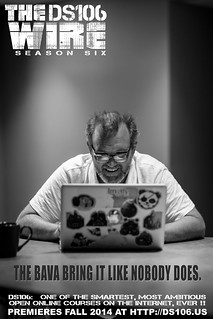
Andrew Forgrave’s #wire106 poster
In preparation for this semester’s wire106, Paul and I started having discussions about the various elements of storytelling in the first three episodes of The Wire. Paul has already blogged his reflections on the first episode of season 1, “The Target,” and what follows below are mine. Also, you can listen to our conversation about it here, but I’m not totally satisfied with the quality of the Google Hangout archive. We’ll be working on alternatives over the next week or so as the class gets going. I guess that’s why we’re starting early.
Switch the soundtrack
There was this one scene is episode 3 of The Wire where the camera pans across Rawls foot up on his desk. I saw that and thought of Dean Wormer from Animal House and his famous speech about putting his foot down (YT). Maybe it would be funny to put the two together. Or maybe it would be stupid. Either way, it’s done and it’s a new assignment.
Doing this was pretty simple, and I’m a bit of an iMovie novice. I used MPEG Streamclip to get the scene, and found a video on Youtube that had the audio and downloaded it. I imported the audio from the video into Audacity and cut it down to the quote I wanted. Then I imported my clip from The Wire and the audio into iMovie. I used the Detach Audio function to take out the sound from the clip, and realized afterwards that I probably could have used that instead of the Audacity trick. I ran into a problem in that my audio was about a second longer than my video, but I was able to squeeze in each end of the audio until it matched the length of the video. It’s not up the the level of the Toy Story + The Wire mashup, but what is?
Episode 3 sights and sounds
Recurring themes
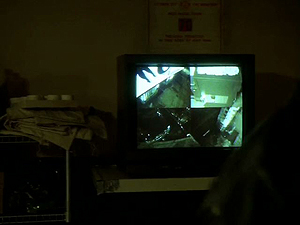
We’ve seen several shots of surveillance so far. Here’s one of the monitor in the office in Orlando’s. It’s only visible for a few frames as D’Angelo walks by, but it caught my attention as an example of surveillance by the surveilled. I suppose the kids doing lookout and yelling “5-0!” are another.
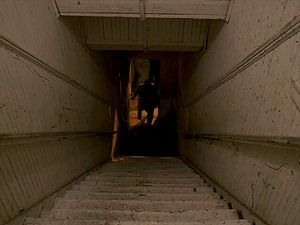
Staircases are a visual metaphor that shows up throughout the series. Going up or down signifies things, like when the squad was sent down to the basement. Here Freamon is about to go up the stairs to a boxing gym. It’s the moment where he goes back to doing real police work, moving up from paper-shuffling.
Color
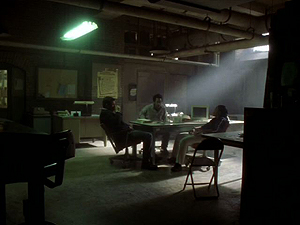
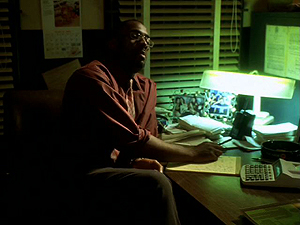
There are numerous examples of subtle color use in the episodes so far. Similar colors show up from scene to scene, which creates a kind of visual harmony. The green cast from the overhead light in the squad room is mirrored by the light on Stringer’s desk.
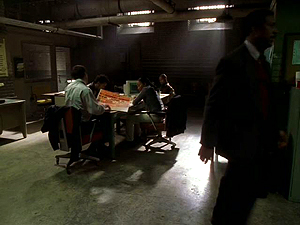
Color is used for contrast as well. The orange of the poster with Barksdale’s picture stands out against the greenish-blue tint of the rest of the shot.
Shadows and light
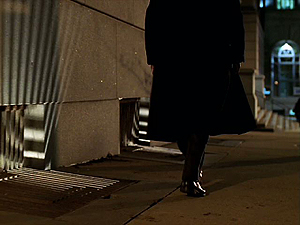
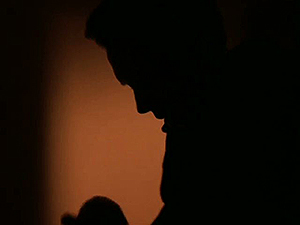
I love the line patterns made by the light coming through the bars in this shot. It’s not a scene of any particular significance, but it ups the aesthetic ante. The silhouette shot from the robbery scenes does as well.

The backlighting effect in the argument between Daniels and McNulty has a nice melodrama to it – very visually striking.
Focus
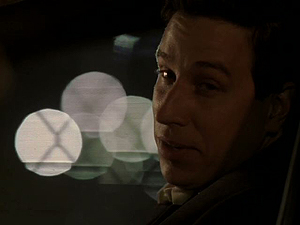
Here is an example of the shallow focus effect that we sometimes see in night time scenes. The face in close-up is in focus, and the background is blurred to the point where all we see are abstract circles.
Sounds
I’m interested in the way sounds tell the story too. The background noise, although it’s sometimes hard to hear without headphones, adds character and atmosphere. In the robbery scene we can hear praise singing from a nearby church. You can hear it in the background in the outdoor shot, but if you listen closely it’s present, though muffled, throughout. It suggests that there are other sides to life in the hood, that there’s more than just the Game.
There’s a scene in the squad room where you can hear some jazzy music coming from a radio. To me at least, it creates a kind of noir atmosphere. Listen to the sound of the door closing – it’s like a jail cell door slamming shut.
This is a scene on the street, as Freamon gets out of his car and walks across the sidewalk to the door to the gym. Listen to all the activity on the street. Except for the one person who accosts the detective, it’s not shown in pictures, just sounds.
